
Wordlessness
A post about St. Thérèse of Lisieux

Hello! I wrote this post during Advent a few years ago for the St. Matt’s blog. Since Advent and Lent are both penitential seasons, Lent is approaching with (frightening??) speed, and I’ve been thinking about St. Thérèse a bit lately, I feel a desire to share with it with you.
I hope you’re finding Christ’s wordless, constant presence with you in the dailiness of your life. <3
Wordlessness
The Story of a Soul is St. Thérèse of Lisieux’s spiritual autobiography. It tells the story of how, at a very young age, she conceived a passionate desire to become a Carmelite nun. She fought hard to be admitted early entry, and took the veil at the young age of 15.
Her text functions, for much of its length, as a story. St. Thérèse possesses a passionate desire and pursues it; she faces obstacles; she tries again. Each time disappointment racks her with suffering, she renews her pursuit of her goal – “Those three months were rich in sufferings,” she writes when her entry date is pushed later than she wishes, “but richer still in graces . . . God made me realize the value of the extra time He gave me; I made up my mind to more serious mortification than ever . . . By these little things I made ready to become the spouse of Jesus” (82-3).
St. Thérèse has, in short, a story to tell. She can, and does, tell that story for as long as her desire for life in Carmel is unmet. Only when she is suffering for lack of her desire’s fulfillment – that is, only as long as her desire is a problem that needs solving – can there be more events, character development, and progression toward a stated goal.
Perhaps, then, it should not be surprising that after she enters Carmel, St. Thérèse’s capacity to tell a story starts to break down. At one point, after several pages of unstructured meditations on prayer, spiritual direction, and convent life, she writes, “But what has happened to my story? I have lost myself in a maze of thoughts. . . . I know my story is nothing but a tangled skein, but it is the best I can do. I simply write things down as they come . . .” (141). This impulse to “write things down as they come” only strengthens in the remaining pages of her text, which look less and less like a story as they go on. However, this in no way diminishes the power of St. Thérèse’s writing. On the contrary, a flame-like passion kindles her increasingly ecstatic language. By the book’s final pages, St. Thérèse has stopped trying to address her Carmelite sisters and instead speaks directly to Jesus with words of intense passion and self-abandonment. Here is an example:
“But to be a martyr is what I long for most of all. Martyrdom! I dreamed of it when I was young, and the dream has grown up with me in my little cell in Carmel. I am just as foolish about this because I do not desire any one kind of torture; I would be satisfied only with them all. . . . Open the Book of Life, my Jesus; see all the deeds recorded of the saints! All these I want to perform for You!” (162)
And another:
“. . . now the law of fear is superseded by the law of love, and love has chosen me as a victim, frail and imperfect as I am. It is surely a worthy choice for love to make, since to be wholly satisfied, it must stoop down to nothingness and turn that nothingness to fire.
. . . No! What I ask for is love. Only one thing, my Jesus, to love You.
Striking deeds are forbidden me. I cannot preach the Gospel; I cannot shed my blood, but what matter? My brothers do it for me, while I, a little child, stay close beside the royal throne and love for those who are fighting.
Love proves itself by deeds, and how shall I prove mine? The little child will scatter flowers whose fragrant perfume will surround the royal throne, and in a voice that is silver-toned, she will sing the canticle of love.
So, my Beloved, shall my short life be spent in your sight. I can prove my love only by scattering flowers, that is to say, by never letting slip a single little sacrifice . . . I want to suffer and even rejoice for love, for this is my way of scattering flowers . . .” (165)
I cannot hope to do justice to the torrent of St. Thérèse’s passion for Christ in this short blog post. I have quoted her at length because she is the best spokeswoman for her own love. Her autobiography is a text I highly recommend, perhaps especially for Lent, in which we spend the daily commitments of our lives practicing a pattern of prayer that was deeply familiar to St. Thérèse: “Every day a fresh disappointment . . . and Jesus slept on . . . This is how her Beloved dealt with His Thérèse – a long testing, and then He realized all her dreams” (82).
When St. Thérèse enters Carmel, she still experiences passionate desire and suffering. What has changed is that she is free to experience them in a manner fully focused on love of Christ. There are no obstacles for her to practice her love for Him in the way she longs to practice it: i.e., with undivided, dogged, tender attention, prayer, and perseverance.
The fact that her capacity to tell a story breaks down in the cloister, as she draws closer to Christ in love, should give us pause. We are a generation of people who are perhaps unhealthily addicted to story. We want to live in a story that’s going somewhere – some quest, or pilgrimage, or love story; a long, difficult journey is alright, we think to ourselves, if a triumph is promised at its end. We want, in short, to be able to narrate what we’re going through and so quantify, shrink, and hold it in our minds.
At first glance, Lent as a liturgical practice seems to support and affirm this impulse. We are, after all, spending forty days in anticipation of a familiar sequence of events: Jesus will enter Jerusalem on Palm Sunday, institute the Eucharist on Maundy Thursday, die on Good Friday, rise again on Easter. But on second glance, this story is marked by a distressing timelessness. Easter already happened, didn’t it? And the New Heaven and New Earth clearly have yet to come . . . so, when we celebrate Christ’s resurrection on Easter, what are we supposed to do with the fact that the healed world is not yet here? What can we make of the necessity to cyclically, constantly — every day, week, month, year — grapple with our sin, imperfection, and suffering; the mundane yet often painful difficulties of our imperfect loves; the need to bring ourselves back to the foot of the Cross — again and again — and plead, again, for new life to come?
As we enter Lent and commit to this season of fasting and prayer, perhaps we are called to give up our attachment to our sense of story. Perhaps Christ invites us to ask ourselves: what if God is good even if I cannot narrate how He is good? What if His goodness, His holiness, and the ways He extends them to me are so good and so holy that they defeat words, leaving me with nothing to say? What if all I have to offer to Him is really, truly, myself — and all I can really do as I make this offering is be silent before Him?
What then, indeed?
The humility we are called to practice in Lent is at least in part the humility of the one who knows words and stories are only helpful to a point. One day, we will have to leave them behind. We will have to present ourselves wordless and open before a God whose love for us is so immense, so holy, it consumes and remakes us like flame.
For now, we enter the quiet days of Lent. We find prayer at the edge of its silence. There is the foretaste of the presence of God, however He chooses to unite Himself to us. And there is our own self, hesitant, waiting, learning the stillness necessary to receive that union – to receive it even as we suffer, even as the stories we want to cling to fall away before its flame.
St. Thérèse again:
“My heart is opened out by charity alone . . . O Jesus, ever since this heart of mine has been consumed by its gentle flame, I have run with delight in the way of Your new commandment, and may I go on doing so until the day when, in Your company of virgins, I will follow You throughout the boundless spaces of eternity, singing Your new Canticle, the Canticle of LOVE.” (132)
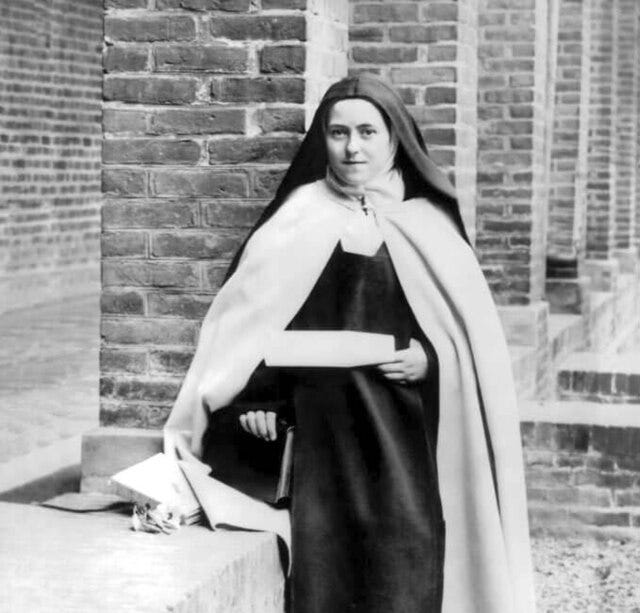
Image source - Wikimedia Commons